
Every few cycles, an infrastructure constraint shifts. In the late 1990’s, when I was at Lucent Technologies, it was telecom infrastructure and the move from copper to fiber optics to meet the coming demand of broadband; in the mid 2000’s, it was a power shortage that was constraining the massive cloud buildout to meet SaaS demand; and now in 2026 the constraint has changed again, this time to the optical interconnect that ties GPU clusters together driven by the current insatiable demand of AI workloads.
This latest generational shift is what brought us to Lumilens. We're proud to announce our participation in the company's Series C, joined by Atreides Management, Bain Capital Ventures, Meritech, and Spark Capital.
The AI cycle is still early
In a recent podcast, Jensen Huang described the AI ecosystem as a five-layer cake: energy, chips, infrastructure, models, and applications. Each layer compounds on the one below it. This view to “demand stacking” is an under-appreciated impact, as analysts tend to focus their models one or two layers at a time, not the full stack.
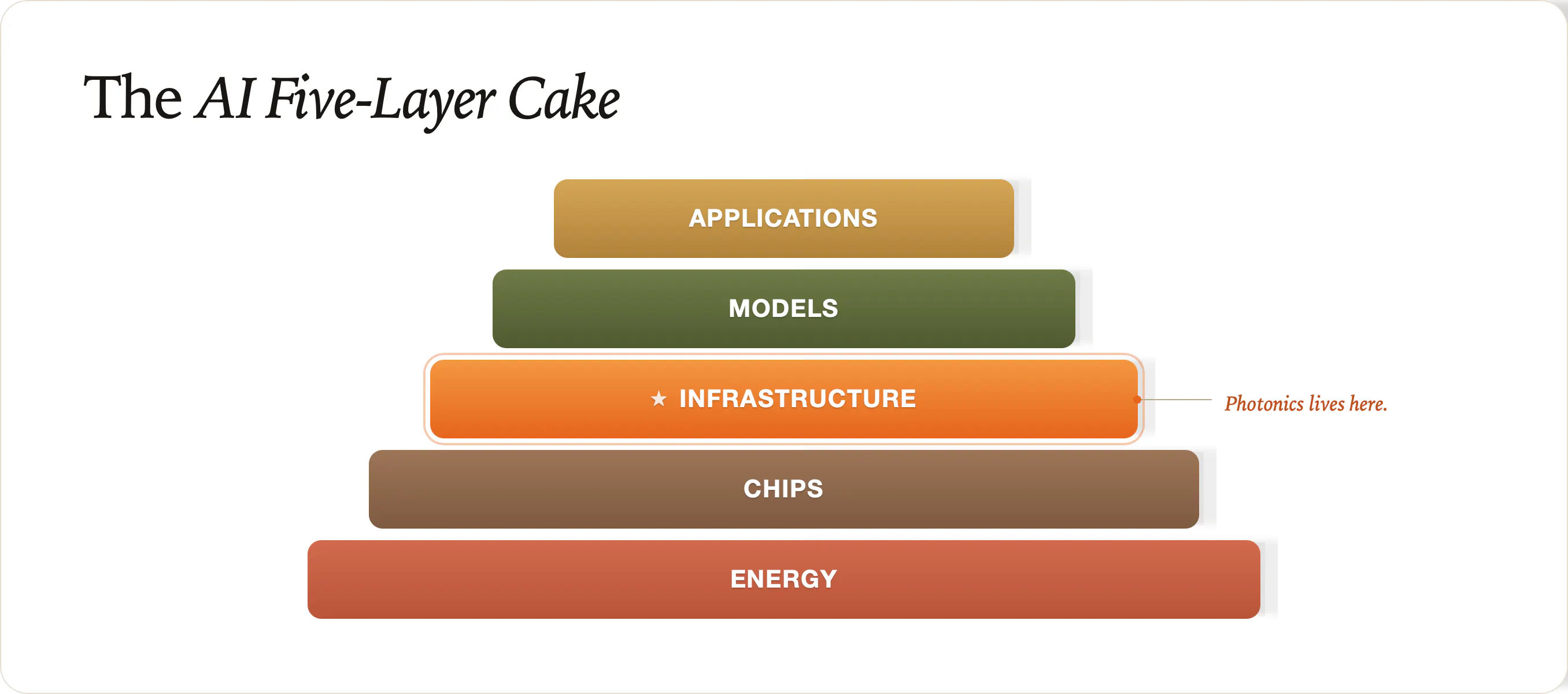
The application layer is still in early innings. Agentic AI is just emerging from experimental use cases into practical production. Each new use case and iteration at the top of the cake pulls demand through every layer beneath it. More applications, more complex applications = bigger models, which mean more infrastructure, which means more chips, which means more energy. The layer in the middle of that pull-through, is where we see the photonics opportunity to come.
The photonics opportunity is a forced transition
We’ve watched the optical transition in networking play out twice before: first in long-haul and metro telecom in the 2000s, then in cloud data centers as 10G gave way to 100G in the 2010s. The dynamic is consistent. Copper carries signals well at one speed, then physics impedes it, the network must shift to light.
The AI datacenter buildout is now running into the same wall, at an accelerating rate. At 200 Gbps per lane, the spec needed for next-generation GPUs, passive copper can only carry signals less than a meter and with the added cost of high heat. As clusters scale from 576 GPUs today to thousands and tens of thousands, the architecture must shift to light.
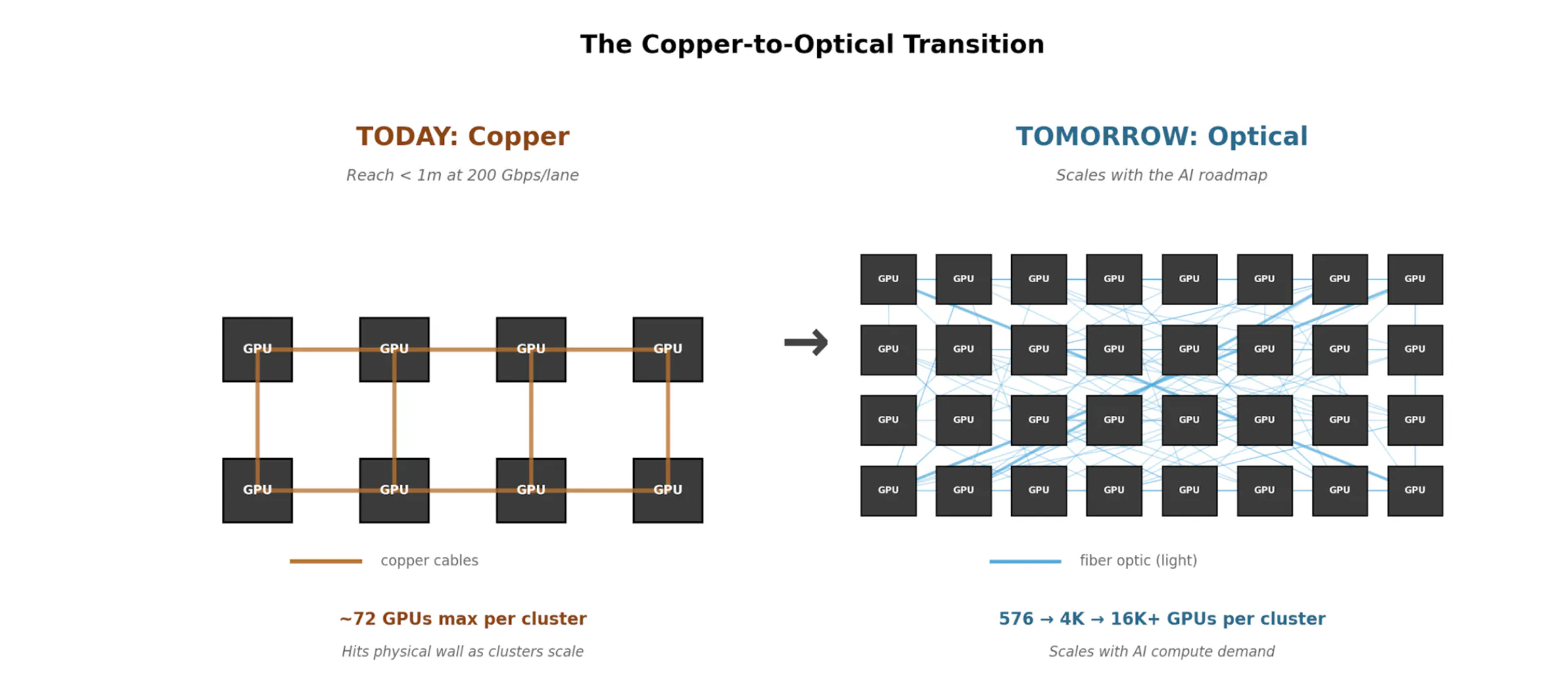
The forced architectural transition from copper to optical interconnect.
The market embraces physics. Goldman Sachs sizes the AI networking market at ~$154B by 2028, up from ~$15B in 2026, a 10x expansion in two years. The capital base has converged on the same conclusion. NVIDIA committed $2B each to strategic investments in Lumentum and Coherent in March 2026 to secure photonics supply for its own roadmap. Marvell acquired Celestial AI in December 2025 to add silicon photonics to its CPO platform. The conviction is no longer ours alone. It’s reflected across the strategic capital base.
Why Lumilens
The companies competing for this transition fall into three camps: established module vendors with scale but narrow product depth, silicon photonics startups with credible technology but no manufacturing footprint, and the large strategic semis building internally as part of broader chip platforms.
Lumilens sits outside all three. The company is building across the full optical transition (pluggables, near-chip optics, and co-packaged optics) on a single in-house silicon photonics platform. It is an ambitious and bold strategy, we don’t know of many other companies attempting that span. The breadth matters because hyperscalers and large AI builders are locking in vendors for the next five years of GPU architectures, and they don’t want to swap suppliers between generations. A company that can support pluggables today and co-packaged optics in 2028 has a structural advantage we expect to compound through the current cycle.
Why we believe in this team
My personal relationship with Ankur goes back to the 2013 timeframe, while I was at Juniper Networks. We bought his company Contrail, which was doing pioneering work on SDN. While investments need a sound strategic thesis, you are still writing the checks to brilliant people and leaders you believe in. I was a believer in Ankur then, and we are huge believers in Ankur today. We continue to be backers of his cybersecurity company Exaforce, and we’ve watched him build teams, win design wins, and scale into large customers. The pattern we’ve seen there is what’s now playing out at Lumilens, only on a larger canvas.
What’s most distinctive about Ankur isn’t the founding count. It’s that the people who’ve worked with him before continue to follow him into new ventures. The Lumilens leadership bench is heavy with engineers and operators who’ve collaborated with Ankur across multiple companies and decades, many of whom I’ve had the pleasure of working with as an operator in the past. Most photonics startups are founded by chip designers reaching into systems and operations. Lumilens is founded by systems builders and networking veterans applying decades of integrated-product experience to silicon photonics. That ordering and practical operational experience matters, further differentiating Lumilens.
The execution to date is consistent with the team’s past track record in previous endeavors. Lumilens has stood up its operational footprint, secured the upstream supply relationships needed to scale, and validated initial products with the kind of customer engagement rarely seen at this stage. Locking down a supply chain before a meaningful ramp is something most early-stage companies can’t do, Ankur and team have done it. It only reinforces our belief in this team.
Why now
Infrastructure transitions don’t happen on a smooth curve. They happen when capacity, customer commitments, and architectural inevitability converge. For AI optical interconnect, that convergence is happening over the next 18 to 24 months. By 2028 the design wins for next-generation GPU clusters will be locked in. The vendors who win slots through 2027 will define the category through the rest of the decade. It’s a small window, and it’s open now.
This is the kind of bet we look to make: a deeply technical infrastructure shift mandated by physics, a team with the operating discipline to execute through it, and a market large enough to support multiple winners with room to compound.
We’re thrilled to be partnering with Ankur and the Lumilens team to build out the future of AI infrastructure.